Rawan's Middle Eastern Fiction Reading Group
Thursday 2nd July, 7pm
Topping & Company Booksellers of Edinburgh, 2 Blenheim Place, Edinburgh EH7 5JH
6.45pm
7pm
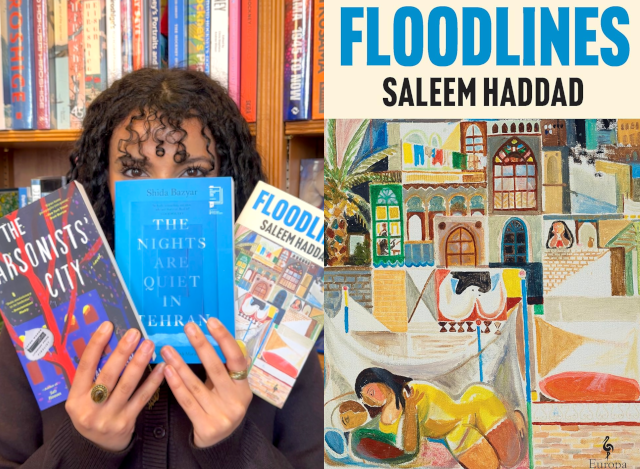
Welcome back to the final installment of the Middle Eastern Fiction Reading Group! We will explore powerful and complex voices from the Middle East, both contemporary and classic, from a region that has an ancient, rich literary tradition. The novels selected illuminate issues of identity, exile, resistance and belonging, told by authors whose work challenges and enriches our understanding of the Middle East and its people.
In July, Rawan has selected Floodlines by Saleem Haddad. From the award-winning author of Guapa, comes Haddad’s brilliant second novel. Set between London and Baghdad, Floodlines is a sweeping, multigenerational tale of art, exile, memory, and the enduring legacies of war.
In the summer of 2014, three estranged Iraqi-British sisters are drawn back into each other’s orbits through the discovery of their late father’s lost paintings.
As Mediha, Zainab, and Ishtar lay claim to his legacy—an inheritance laced with exile, betrayal, and an Iraq they no longer recognise—Zainab’s son Nizar, a war correspondent haunted by his time on the front lines, returns to the family fold. As summer bleeds into autumn and the truth about the paintings unfurls, the family is forced to confront the personal and political betrayals that tore them apart.
Spanning continents and decades, Floodlines grapples with grief and memory, and charts the emotional and political aftershocks of a century of war and revolution in Iraq and beyond. Inspired by the artistic legacy of Haddad’s great uncle, the Iraqi modernist painter Jewad Selim, Floodlines explores family, queerness, and the wounds of (neo)colonialism in haunting, visceral prose.
“A hugely ambitious novel...Beyond the skill of its prose, Floodlines is humane and moving.” — Asian Review of Books
"In asking what it means to make art, Floodlines manages to be cinematic and essayistic in the same breath. Above all, it manages to fuse the intimate subjectivity of disinheritance and displacement with unfolding history. An epic vindication." — Youssef Rakha, author of The Dissenters
"A low rumble vibrated through the soles of his shoes. He imagined the train’s approach, the burst of stale air it would bring with it, the twin beams piercing the darkness, growing larger, closer. He imagined his body: limbs twisted, bones shattered, blood mixing with the oil and grime of the tracks. Would it be quick? A flash of pain and then nothing? Or would it linger, his consciousness trapped in a broken body as the world spun above him?
He closed his eyes and was back in Baghdad, among the strewn bodies, the contorted limbs, the furnace of heat. He took a breath, his lungs filling with damp, metallic air. The smell of charred flesh and rubber was suffocating. He felt the blood drip down his cheek, the terrifying silence that preceded the screams— A hand on the back of his neck. Uninitiated skin-on-skin contact, a cataclysmic subversion of the unspoken rules of the metropolitan transport system.
In another situation Nizar might have smacked aside the stranger’s hand, but an intimacy in the touch stopped him. The hand pulled him back, rooted him in the present. He opened his eyes as the train thundered by, a blur of white and blue. A gust of wind whipped at his clothes. The disquiet retreated, a wave drawing back into the sea."