Rawan's Middle Eastern Fiction Reading Group
Tuesday 5th May, 7pm
Topping & Company Booksellers of Edinburgh, 2 Blenheim Place, Edinburgh EH7 5JH
6.45pm
7pm
Welcome back to the final installment of the Middle Eastern Fiction Reading Group! We will explore powerful and complex voices from the Middle East, both contemporary and classic, from a region that has an ancient, rich literary tradition. The novels selected illuminate issues of identity, exile, resistance and belonging, told by authors whose work challenges and enriches our understanding of the Middle East and its people.
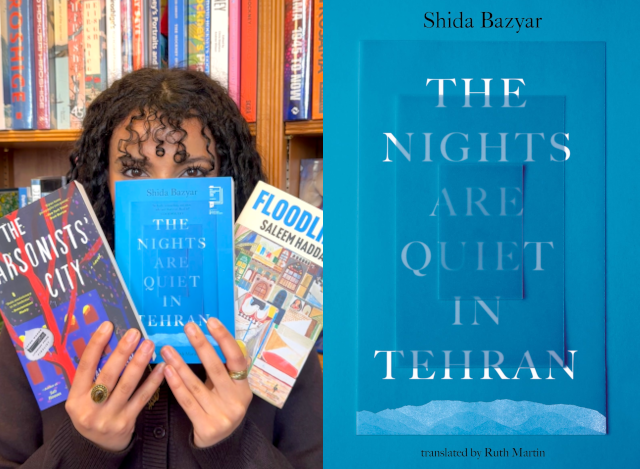
In May, Rawan has selected The Nights are Quiet in Tehran by Shida Bazyar (Translated by Ruth Martin). Longlisted for the International Booker Prize 2026, this novel is set across four decades, from 1979 to 2009, a polyphonic novel of one family’s flight from and return to Iran.
1979. Behsad, a young communist revolutionary, fights with his friends for a new order after the Shah’s expulsion. He tells of sparking hope, of clandestine political actions, and of how he finds the love of his life in the courageous, intelligent Nahid.
1989. Nahid lives her new life in West Germany with Behsad. With their young children, they spend hour after hour in front of the radio, hoping for news from others who went into hiding after the mullahs came to power.
1999. Laleh returns to Iran with her mother, Nahid. Between beauty rituals and family secrets, she gets to know a Tehran that hardly matches her childhood memories.
2009. Laleh’s brother Mo is more concerned with a friend’s heartbreak than with student demonstrations in Germany. But then the Green Revolution breaks out in Iran and turns the world upside down.
The Nights Are Quiet in Tehran is a moving novel about revolution, oppression, resistance, and the absolute desire for freedom.
"My nieces and nephews run and play between the women, knowing that the moment is approaching when first I and then they will be sent out and they will have to find a new game. There isn’t much to snack on when vine leaves are being stuffed; the rice mixture isn’t very interesting, and the leaves don’t taste good without their filling. When there’s nothing to snack on, you can make a nuisance of yourself. My niece is the smallest, and she wants the smallest dolmeh. My brother Mehrdad is the fattest, and he wants the fattest dolmeh. The women give in with a laugh, planting kisses on the children’s cheeks.
If I were a mother, a sister, an aunt, I would be sitting there doing the same; I would take every opportunity to kiss these little souls, because they’re so joyful, and no matter what is happening outside, no matter what they’re learning at school, no matter that their schoolbooks are suddenly endorsing the opposite of what they did a few weeks previously, no matter if a while ago their parents were still spending their nights on the roof and their days on the streets, returning with bloodied clothes — the children still spend their days laughing, questioning, eating, interrupting, sleeping. They deserve all the kisses in the world, I think, but maybe the life that is just around the corner, still wavering a little — maybe that is the much greater gift."
‘What actually happens after a revolution? Through cycles of flight and return, exile and assimilation, Shida Bazyar takes readers through four decades in the lives of an Iranian family. The pages of The Nights Are Quiet in Tehran pulse with solidarities and betrayal, with heartache and humour. And for all exiles, migrants, once-and-future revolutionaries, Bazyar captures what it means to always live in hope.’ - International Booker Judges, 2026